It's impossible to ignore the decline of the paper book, what with the introduction of easily-accessed virtual copies of nearly every book to have ever been written and the constant increase in prevalence of portable e-readers. Books will probably be printed less and less as time goes on; eventually there will be no use or need for physical copies of books, made entirely of resources that humanity has become more and more worried about losing. Eventually, every physical book will be an antique and the book market will become populated entirely by collectors and individuals stuck in the past. People will stop printing books for the same reason that people have stopped widely using scrolls -- it's simply not practical anymore.
If there's anything we learned in this course though, it's that the medium and appearance of the book is not what makes the creation a book. It is the idea, the permanence of the story, the exchange between reader and writer, that makes a book a book. So, even though paper will soon be out of date, books will continue indefinitely. There's no end to people willing to share their thoughts, and there's no end to people that are willing to absorb the ideas of others. As long as that remains true, the future of books has no end.

Sunday, December 9, 2012

Friday, December 7, 2012
The future of books?
I can't tell you how much this class has enlightened me on how books were made and what little things can be looked at to figure out the character that each book contains. We were even able to experience the exact methods that people used before computers to make paper, carve images, and set type before printing and binding the books.
Unfortunately, I think that the age of books is declining a little bit in the face of new technology in the form of Nooks, Kindles, and other Ebooks. Even though these new forms of reading have drawn other people into reading the books that we all know and love, it seems like these same books are being pushed out as well. So I guess my question is: are books a dying breed? or will they always have some place in today's society? Personally, books will always have a special place in my heart, and be important to my sanity: a place that even my Kindle can't fill
Unfortunately, I think that the age of books is declining a little bit in the face of new technology in the form of Nooks, Kindles, and other Ebooks. Even though these new forms of reading have drawn other people into reading the books that we all know and love, it seems like these same books are being pushed out as well. So I guess my question is: are books a dying breed? or will they always have some place in today's society? Personally, books will always have a special place in my heart, and be important to my sanity: a place that even my Kindle can't fill
Thursday, December 6, 2012
Stories in the Making in a Nutshell
The process
of making our books taught me so much about a subject that I had previously
known very little about. We were able to go through the outdated process of
making a book that the people in the 1700’s went through in order to publish
books. We were taught the process of making paper, binding a book, setting
type, and using a Benjamin press. All of these are things that I had previously
known nothing about and never dreamed of being able to do. The reason I showed
interest in this particular seminar is that I really love objects with history
and a story behind them which made this class about historical books and the
method to make them so interesting to me.
On the last day of class, Dr.
Samuelson gave us a parting speech that asked us to think about the future of
books. With the growing popularity of Nooks and EBooks, paper books may one day
be deemed obsolete, and bookstores will go out of business much like the movie
rental business. I had previously thought about this topic and had even written
about it earlier in the year on the seminar’s blog page, but I have thought
about it much more now. In some ways, not having the traditional books could be
useful such as not having to spend hundreds of dollars on college books and
instead paying much less for online books. Online books would also never go out
of stock like the traditional paper books do. After making our books from
scratch though, I have come to respect paper books so much more and understand
their significance. Books contain within them secrets of the past that EBooks
could never have. If I wrote my name and the year I made it on my book I made
and someone a hundred years from now picked it up, they would know who owned
that book and around when it was made. Every mistake I had made in making the
book would be evident, but these mistakes would give the book character. Uneven
binding would help distinguish my book from my fellow classmate’s similar
copies. These differences are what make books so important to history. We have
studied again and again historical books in class that, through the seal
stamped on the inside cover or the opinions of a past reader on the margins of
the book, we can trace the history of the book and know its story. I have come
to learn that if traditional paper books disappear then a large part of history
might as well.
In all, I greatly enjoyed this
seminar. It not only taught me an amazingly awesome (if outdated) skill, but it
also taught me how very important books are to our history.
Wednesday, November 28, 2012
Inking and Printing
Inking and printing was a hands-on activity that was so much fun. Most of time I ended up doing the inking, which was interesting. In order to get all of the letters sufficiently covered in ink, one must roll the roller over each section in a plethora of directions about a trillion times. And then there's always that one corner at the very edge of the page that is lighter than the rest, because apparently in the Great Inking of the Letters, that one section was stubborn and refused to succumb to the great powers of my inking roller.
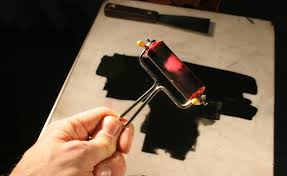
I also enjoyed the experience of making sure the words got onto the paper through the wonderful art of printing. It's pretty interesting to learn that some people were so fast with those archaic machines at some point. The swinging must have been intense, because I wasn't moving that quickly and the printer swayed whenever I pulled the bar to clamp the print down onto the paper. However, I really enjoyed that part, and felt that if I were working in a book-making factory back in the Golden Ages, I should not so much mind just swinging from that bar clamp all day. It took me leaning with all my weight to make sure everything was pressed down sufficiently. So I could pretend that I was on a ship or something and it was swaying back and forth, and I was just holding onto the railing. It's a highly metaphorical image, but if I was to do the same monotonous motion all day, I would attempt to add some creativity to an otherwise easily worn-out task.

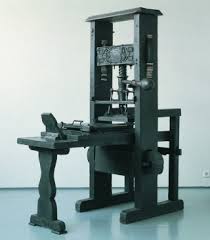
The similarity between the two machines is striking. Anyway, I very thoroughly enjoyed the overall process, and it is something I should be glad to have a chance to do again sometime in the future!
I also enjoyed the experience of making sure the words got onto the paper through the wonderful art of printing. It's pretty interesting to learn that some people were so fast with those archaic machines at some point. The swinging must have been intense, because I wasn't moving that quickly and the printer swayed whenever I pulled the bar to clamp the print down onto the paper. However, I really enjoyed that part, and felt that if I were working in a book-making factory back in the Golden Ages, I should not so much mind just swinging from that bar clamp all day. It took me leaning with all my weight to make sure everything was pressed down sufficiently. So I could pretend that I was on a ship or something and it was swaying back and forth, and I was just holding onto the railing. It's a highly metaphorical image, but if I was to do the same monotonous motion all day, I would attempt to add some creativity to an otherwise easily worn-out task.
The similarity between the two machines is striking. Anyway, I very thoroughly enjoyed the overall process, and it is something I should be glad to have a chance to do again sometime in the future!
Friday, November 9, 2012
Mind your P's and Q's
Tuesday, November 6, 2012
Type!
This week/last week we were able to set type, which is actually a really soothing activity. I found that once I got to working on setting out my paragraph and finding the letters, my hands started to remember where the letters were and it became muscle memory to just go grab the letter I needed. I wasn't sure how exactly the process worked at first, because I had never really seen the type itself or the method in which it was held. But once I saw how everything was set up, it was pretty clear to me how it worked.

What amazed me, though, was thinking back to how people used to make entire newspapers by doing this. And some newspapers were daily editions, so the type had to be set and changed every day. Not only that, but there were stories that needed to be written before they were set in type, and then the type needed to be checked for errors. That makes today's methods of printing newspapers seem SO much easier. Seems to me that there shouldn't even be mistakes in today's newspaper, considering all we have to do is click on some letters and use spell check to correct things. And mistakes can be removes supremely easily. It's a wonder to me that people were able to make so much using movable type.

However, I really enjoyed the activity, and would like to do it again. For me the fun was just in finding the letters and seeing how efficient I could become, how fast I could go without making a mistake. In all of my efforts, I only ended up making one mistake, which was an inverted period. That's what I get for competing with myself!
What amazed me, though, was thinking back to how people used to make entire newspapers by doing this. And some newspapers were daily editions, so the type had to be set and changed every day. Not only that, but there were stories that needed to be written before they were set in type, and then the type needed to be checked for errors. That makes today's methods of printing newspapers seem SO much easier. Seems to me that there shouldn't even be mistakes in today's newspaper, considering all we have to do is click on some letters and use spell check to correct things. And mistakes can be removes supremely easily. It's a wonder to me that people were able to make so much using movable type.
However, I really enjoyed the activity, and would like to do it again. For me the fun was just in finding the letters and seeing how efficient I could become, how fast I could go without making a mistake. In all of my efforts, I only ended up making one mistake, which was an inverted period. That's what I get for competing with myself!
Monday, November 5, 2012
The Smallest Beginnings
It's hard imagine that books that can be as big as a computer can come from such small beginnings. So many pages and so much writing comes from tiny little pieces of lead. Something as complex as, say, the bible was made up of tiny little letters individually placed. The amount of work required to make a book in the past is incredible.
One also has to consider the frustration that would come from messing up a sentence, or even just one word. It might mean you would have to redo the entire thing, and that would take forever. And if the entire phrase falls apart, that's even worse. It makes you appreciate how much work was put into books by the printers.
Also, I wonder if they ordered different style of letters for different books. If all of the books from a publisher were in the same style, I would wonder if people who wanted a specific style of text would go to a different printer. An interesting way to cause rivalry.
Subscribe to:
Posts (Atom)